
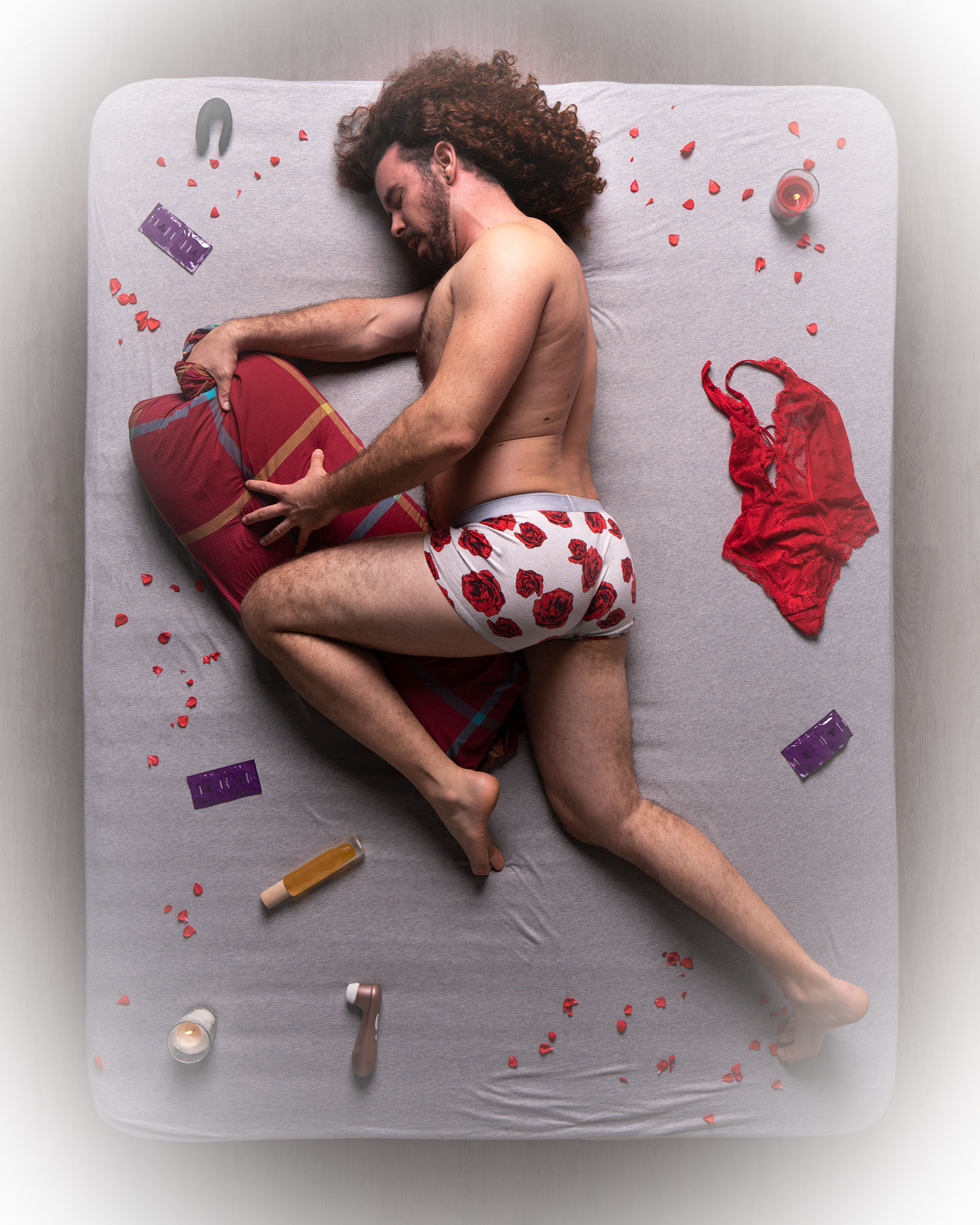
There are dreams in which the subconscious decides to create its own erotic film without asking permission. It's that state of suspension where the imagination runs wild and fills the gaps left by reality. In this daily interlude, one becomes the protagonist of a story brimming with rose petals and promises, even if the setting is as mundane as one's everyday mattress.
What's fascinating about these fantasies is the gap between what we project and what actually exists. It raises the question of whether these dreams are a necessary outlet or simply reminders of our most basic desires. Where does biology end and the cultural construction of our fantasies begin? Is instinct something pure that we try to tame with embellishments, or are those very embellishments what keep alive the flame of an impulse that, otherwise, would seem too animalistic?
In the end, what's clear is that the mind is capable of creating a feast from just a few crumbs. There's nothing wrong with indulging in fiction now and then; the problem arises when the light comes on and you discover that all the theatrical spectacle hasn't satisfied a hunger that sleep can't cure.
And so, while Gonza was starring <Glad-He-Ate-Her>, I went crazy trying to tame all that lion's mane, which, I must say, is not Photoshop, it was my real hair.


TECHNICAL INFORMATION AND PUBLISHING COMMITMENT
If you have decided to purchase a unit of Wet dreams, you've made an excellent choice. You're not investing in just another photograph: i don't sell catalog prints. While a large print shop might produce 100,000 copies of a blank image for any waiting room, I'm limiting this essay to a select few. It's the difference between decorating a wall and imbuing it with an identity shared by only a small group of people.
Why such a small edition?
- Workshop Warranty: Limiting the series allows me to personally certify that every cotton fiber and every drop of ink is exactly where it should be.
- Finitude: Just as an honest conversation can't have a thousand participants at once without getting lost, these pieces are limited in size so that the dialogue between the paper and the viewer remains intimate. We don't want to trivialize ideas that have taken years of study as if they were just a merchandising product.
Display standard
- Paper: I only use the best exhibition photographs papers: Canson Baryta 310 g/m² and similar.
- Authenticity: Each work includes certificate of authenticity signed by hand and a system of double void hologram to ensure the integrity of the copy.
File note: Apart from the 100 limited editions, there are 2 AP and 3 large format museum edition copies (Giclée process).
Printer's Note: I apply standard museum margins (10% on the sides/top and 20% on the bottom). The artwork is signed on the right margin, but if you prefer it signed on the back or without the signature, I can adjust that. What matters is the idea.
Shipping: I'm deliberately overly cautious with the protection; it personally pains me to see a piece arrive damaged. Inside the package, you'll find the artwork wrapped in acid-free tissue paper, a certificate of authenticity, care instructions, cotton gloves, and a few other surprises. I also use recycled wood and cardboard with as little plastic as possible to make the packaging environmentally friendly.
* Shipping included within mainland Spain and the Balearic Islands. For other areas, shipping costs are calculated automatically before payment.