the journal: where ideas take shape
If storytelling seeks to tell a story in an image, philosophical photography seeks to capture a thesis. I'm not interested in anecdotal narratives, but rather in human thought in all its facets: from the meaning of life or the poetry of the everyday, to the power of love or social critique.
Contrary to academic definitions, the philosophical photography you'll find here isn't simply about pasting text onto an image. Here, philosophy is observed. I use self-portraiture and composition to create clear and unambiguous messages, where the title is the key that unlocks the door, but the image itself is the room of our thoughts. In this collection, you'll discover how an idea travels from the subconscious to your living room wall.
THE THOUGHT
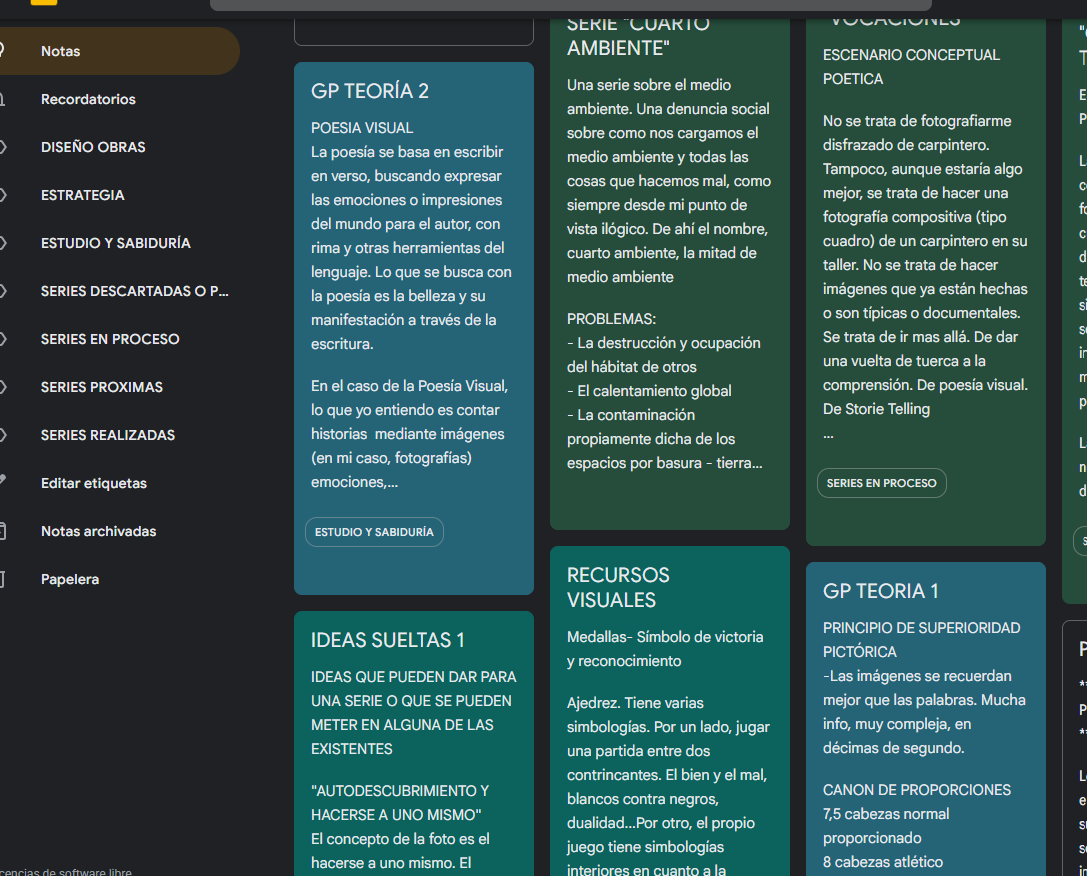
I could romanticize this part of the project. My initial idea was indeed that: a couple of pretty notebooks, some hand-drawn sketches like a true Renaissance artist, and voila, a masterpiece. But the reality is much more tedious and repetitive work. Here's a snapshot of the hell that is my notes. Disorganized ideas, possible ideas, terrible ideas, brilliant ideas that haven't yet taken shape or found their place in the work. They might find it, or they might never leave those notes. Contrary to what many people think, quite a bit of time passes before even reference images begin to enter the process.
The stark reality is that behind each series lie years of thought. Yes, you read that right, years. I spent a decade pushing the boundaries of traditional photography (weddings, nature, technique) until I understood that I didn't want to capture what I saw, but what I thought. I have a chronic inability to look at something without trying to dissect it. I like to design and I like to categorize. I enjoy structuring my thoughts. About five or six years ago, the idea suddenly emerged. I peered into an abyss that was quite dizzying. My consultant's mind (yes, I worked for multinational corporations until not too long ago) was accustomed to structuring everything. My first impulse was to try to 'tame' the ideas. But an experiment like this isn't managed like a technology project. It took me a while to understand that for the artist to work, the consultant first had to accept that he was lost. I started studying and researching a lot about many things. As in any contemporary discipline, rigor demands constant updating… you have to stay up to date on everything and internalize new concepts or renew the ones you already have.
It wasn't until 2024 that I had the courage to leave my job and other commitments and focus entirely on my work. I believe that to have these kinds of ideas, I had to go through absolutely everything. I began to relate concepts, to connect one theme to another, and to develop this framework I have now, which will allow me to reach the bottom of the rabbit hole. And that's how the powerful pieces began to emerge.

In ‘The Attic’ I achieved for the first time that balance between acerbic humor and subtlety that I was looking for. It’s a piece that doesn’t reveal itself at first glance, but rather unfolds in the details. The one who looks quickly sees a ghost; the one who observes finds a walking stick. The mystery isn’t who’s under the sheet, but all the questions it raises afterward. What must that final stretch of our lives be like to be considered worthy? That ‘Grandpa Gonza’, Did he deserve to be surrounded by his own people, or was he a bad person who deserved to be ostracized? Or perhaps he himself went up to the attic to abandon himself?
THE PRODUCTION
Once the idea is clear, I stop being a pen-and-paper philosopher and put on my work clothes (yes, I had a renovation company in my twenties, so I still have some overalls lying around the house). The first part is pure freedom: letting my imagination run wild. I was given a piece of advice that I always follow: "Think about the photos as if you didn't have to take them." It's a huge challenge, because once you have the idea in your head, you can't sleep until you see it on paper. I start with sketches and diagrams. There's a lot to decide: the composition, the light, the axes… variables that aren't aesthetic, they're tools to reinforce the message. How the elements speak to each other, the atmosphere of the photo… I leave nothing to chance.
Once I can visualize the image in my mind, the production process begins. Photomontage and collage have always been present in my work because, unlike documentary or nature photography, where reality is sacred, in my work reality serves the idea. Photomontage isn't a trick; it's the construction of a scenario for the message to come to life. What matters to me is giving life to a complex idea and generating an initial visual impact that leads to a deeper analysis of the image and concludes with a question (or many) in the viewer's mind. These days, AI has become a great ally. Many people are frightened by artificial intelligence, but for me it's very practical; it's another tool that neither diverts nor dictates the course of the message, but allows me to execute it with the precision I seek. Furthermore, it allows me to drastically minimize the carbon footprint of my work. What integrity would I have as an artist if, to create a photograph denouncing social issues related to atmospheric pollution, I used tons of CO2 to produce it?
What I do is impose a series of rules on myself to safeguard the idea. I'm not trying to create fantasy or surreal worlds: the final photograph has to look real. Technology gives me the freedom to imagine any scenario, but it's not an excuse to be lazy. I love being in the studio surrounded by lights, tripods, and accessories. If I can get something in the real world, I prefer that to creating it digitally.
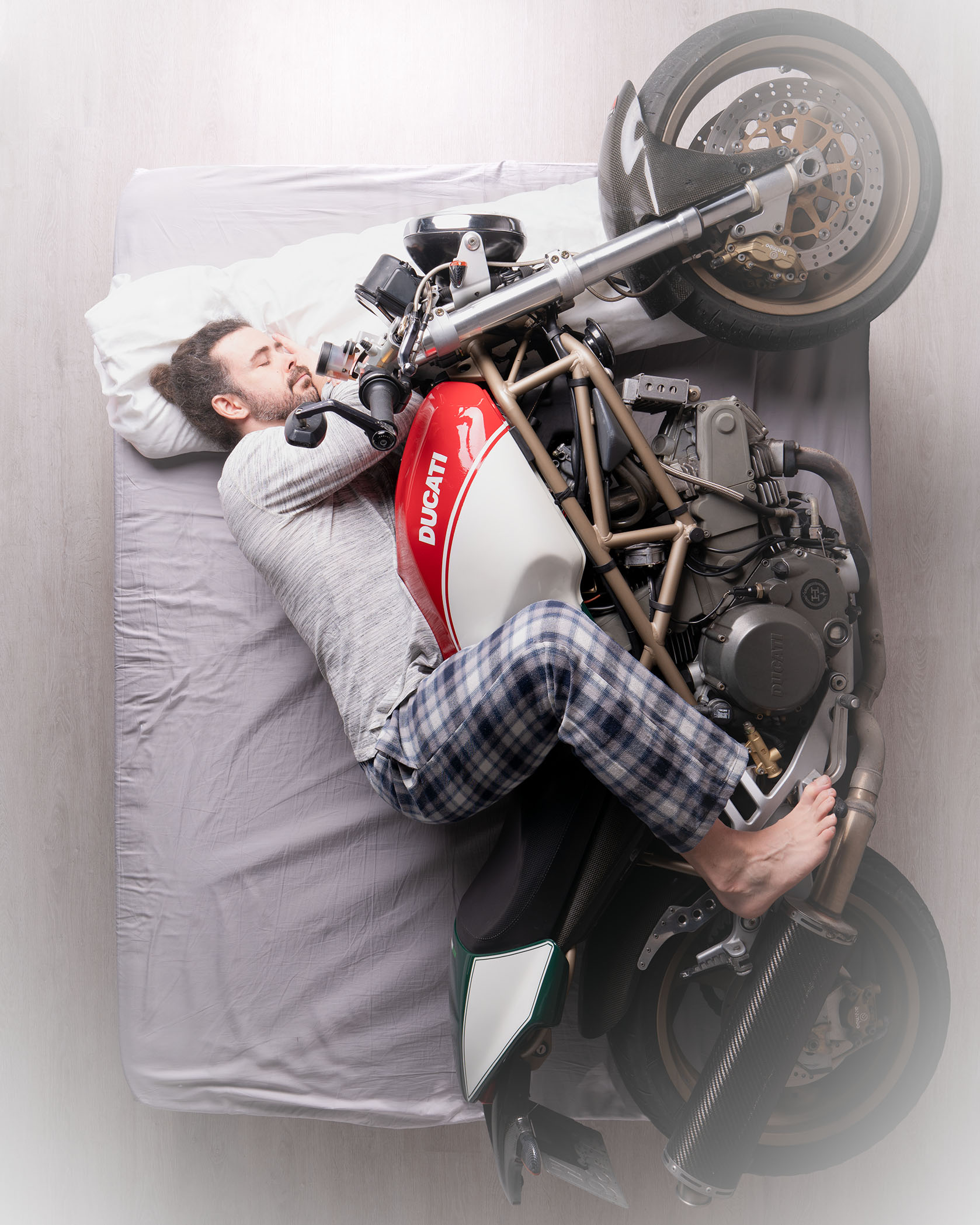
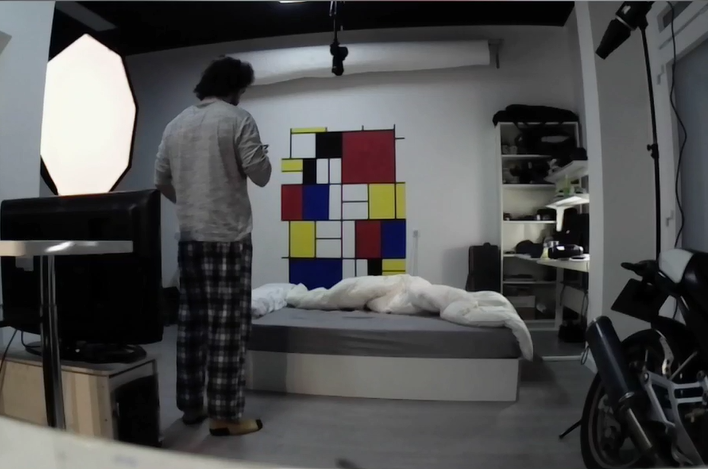
During the production of "The Rider," a bed was destroyed and several liters of gasoline and oil spilled onto the floor. I think sleeping with a 200 kg Monster was somewhere between genius and madness.
Then comes the execution, and sometimes it's bittersweet. If, when I see the shot on camera, the idea doesn't work, however painful it may be, I have to be honest and rigorous enough to undo what I've done and throw the work away. Not everything is worthwhile; I only move forward if the piece truly deserves to exist in the real world. When a production finally passes the filter, the last step before bringing a piece to life involves hours and hours of editing and reflection. Physical tests on paper, advice from colleagues, and finally, we head to the studio.